
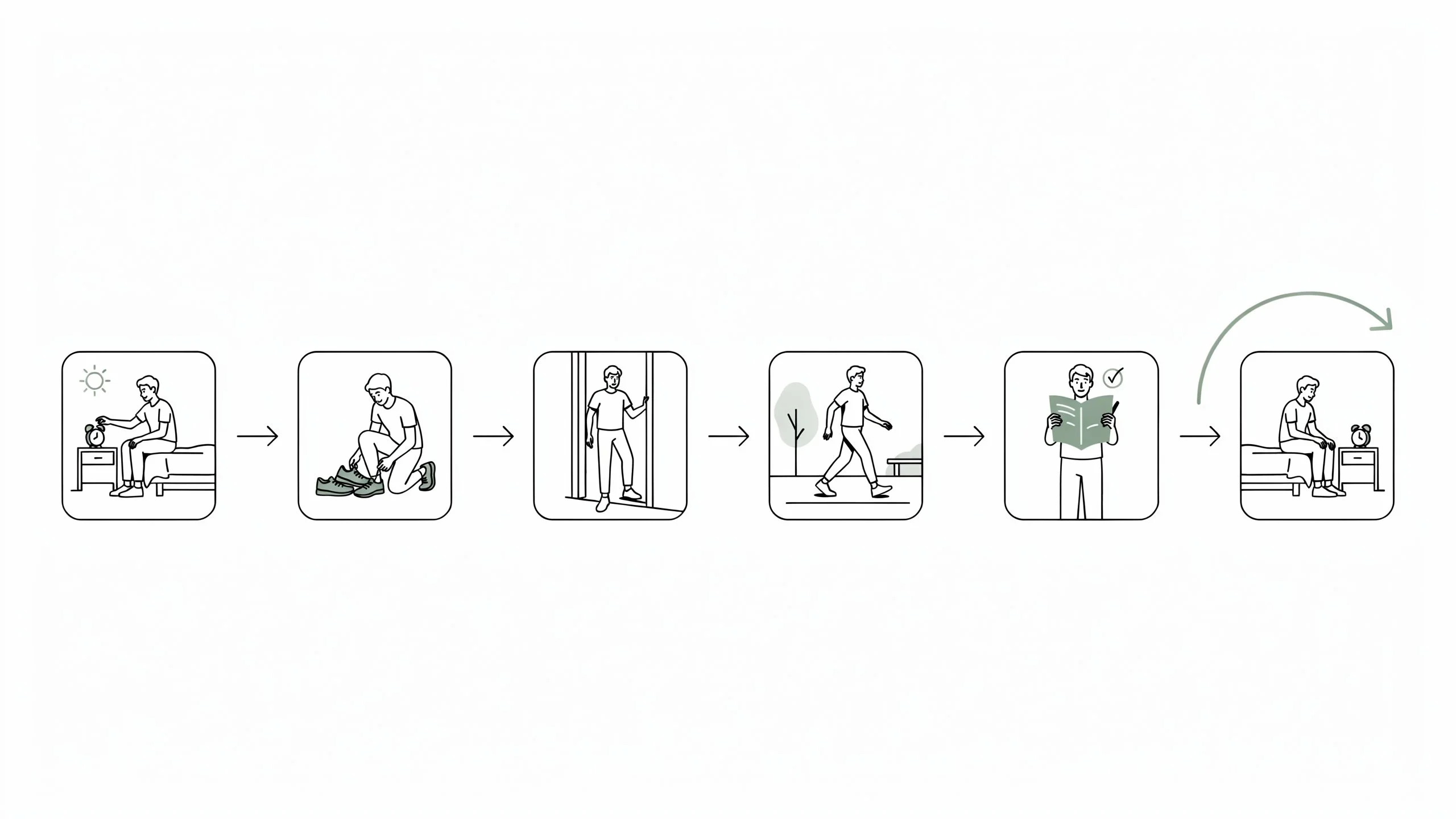
This 30 day walking plan for beginners starts with 10 minutes a day and adds about 5 minutes each week until you reach 30 minutes by week 4. You don’t need a watch, an app or a gym. A phone timer or a wall clock is enough.
- Week 1: 10 minutes daily at an easy pace
- Week 2: 15 minutes
- Week 3: 20 minutes, with a brisk finish
- Week 4: 25 to 30 minutes
- The one rule: never skip two days in a row
Why Most Beginners Quit Walking Plans (It Isn’t Laziness)
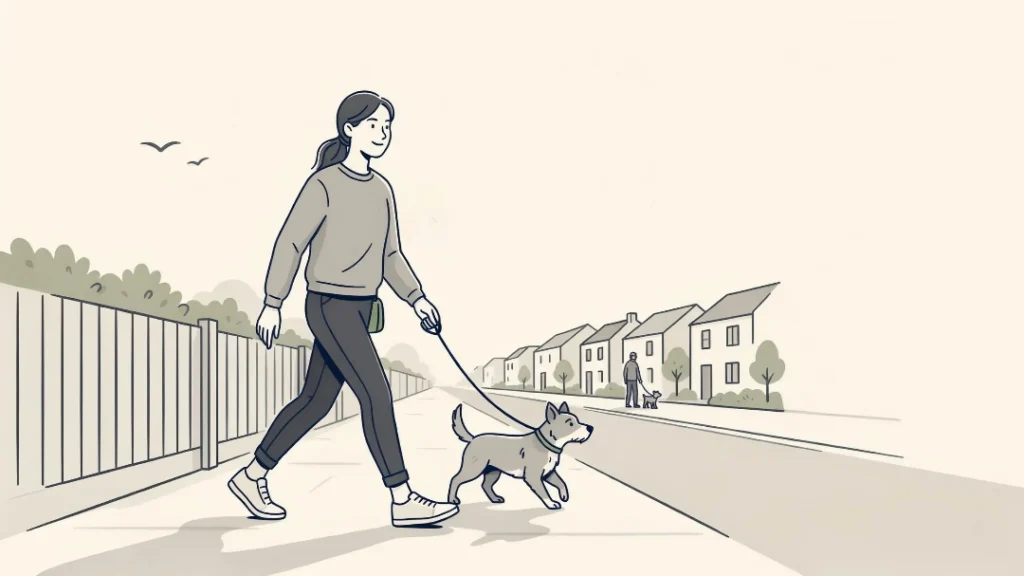
My first attempt lasted six days. I watched a video, decided I’d walk an hour every morning at 5:30, and felt great on day one. By day three my shins hurt. By day five I was “too tired.” On day six I told myself I’d restart on Monday. Monday never came.
I’ve seen the same pattern in almost every friend I’ve coached since. The problem is rarely discipline. It’s the plan.
What actually goes wrong
- The start is too big. An hour a day is a performance, not a habit. Your brain treats it as a cost, so it looks for an exit.
- Plans assume gear you don’t have. Almost every 30 day walking plan for beginners I found wanted a fitness watch, a step-counting app or a data plan. If you’re on a cracked phone with no money for extras, they quietly fail you.
- All-or-nothing thinking. Miss one day and the whole thing feels ruined. Psychologists call this the “what-the-hell effect,” and it kills more habits than any busy schedule.
- Motivation is the only fuel. Motivation is high on day one and unreliable after that. A plan that needs it every morning will stall.
How Many Minutes Should a Beginner Walk?
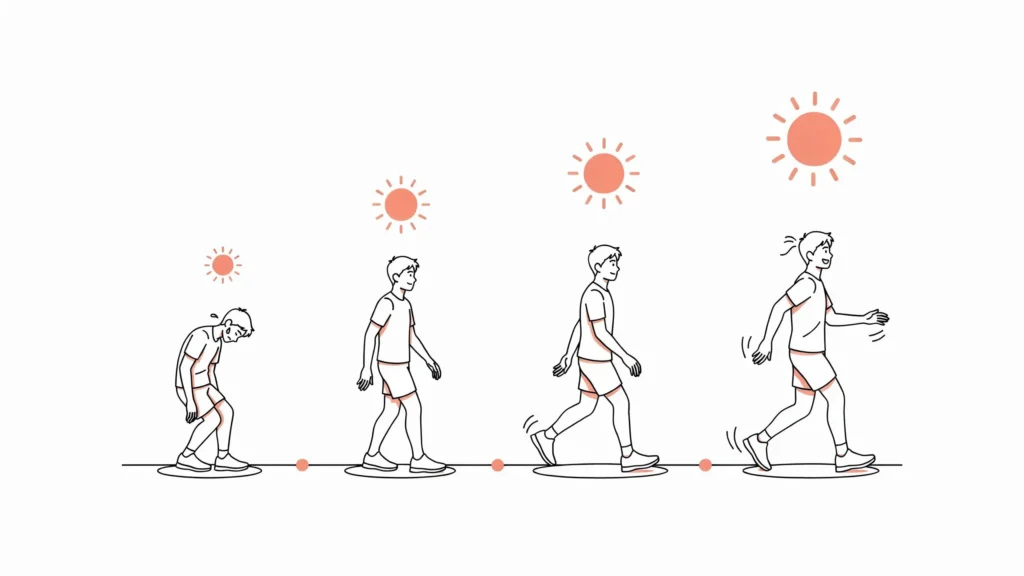
It depends on where you’re starting from. Here is the simple version I give everyone:
- Mostly sitting all day: start at 10 minutes.
- Somewhat active already (stairs, errands, sports now and then): start at 15 to 20 minutes.
- Out of breath after a few minutes: start at 5 and add a minute every couple of days.
The long-term target is 30 minutes on most days. That adds up to roughly 150 minutes a week, which matches the WHO’s activity guidance for adults.
Add about 5 minutes a week, not more, which is exactly how this 30 day walking plan for beginners is built. Your joints, your calves and your motivation all adapt more slowly than your enthusiasm does.
The Day-by-Day 30 Day Walking Plan for Beginners (Minutes, Not Miles)
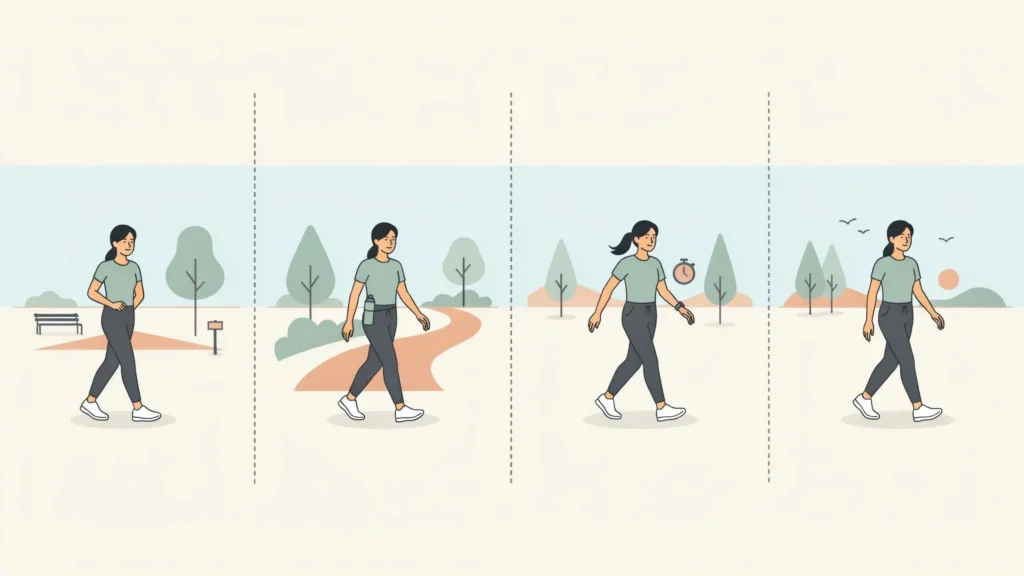
This 30 day walking plan for beginners ignores distance and step counts. Set a phone timer or watch the clock, and walk for the minutes listed. That’s the whole system.
Use the talk test to check your pace:
- Easy: you could chat or even hum without effort.
- Steady: you can speak full sentences, but you notice your breathing.
- Brisk: you can talk, but you couldn’t sing.
| Day | Minutes | Pace | What to do |
| 1 | 10 | Easy | Walk out, turn around at 5 minutes |
| 2 | 10 | Easy | Same route, same time as yesterday |
| 3 | 10 | Easy | Try it right after a meal |
| 4 | 10 | Easy | Silence your phone before you leave |
| 5 | 10 | Easy | Pick a new direction |
| 6 | 10 | Easy | Ask a friend or sibling to join |
| 7 | 10 | Easy | Light day. Tick off week 1 |
| 8 | 15 | Easy | Add 5 minutes. Slow down if needed |
| 9 | 15 | Easy | Keep the same route as day 8 |
| 10 | 15 | Easy | Last 2 minutes a little faster |
| 11 | 15 | Steady | Notice your breathing |
| 12 | 15 | Steady | Relax your shoulders, swing your arms |
| 13 | 15 | Steady | Walk with your head up, not on your phone |
| 14 | 10 | Easy | Light day. Tick off week 2 |
| 15 | 20 | Easy | Add 5 minutes. Easy pace only |
| 16 | 20 | Easy | Last 3 minutes brisk |
| 17 | 20 | Steady | Pick a landmark to speed up toward |
| 18 | 20 | Steady | Last 3 minutes brisk |
| 19 | 20 | Steady | Walk a different time of day |
| 20 | 20 | Steady | Last 5 minutes brisk |
| 21 | 15 | Easy | Light day. Tick off week 3 |
| 22 | 25 | Easy | Add 5 minutes. Start slow |
| 23 | 25 | Steady | Last 5 minutes brisk |
| 24 | 25 | Steady | Try a gentle hill or some stairs |
| 25 | 30 | Steady | Your first full 30 |
| 26 | 30 | Steady | Last 5 minutes brisk |
| 27 | 30 | Steady | Walk to somewhere you actually need to go |
| 28 | 20 | Easy | Light day. Tick off week 4 |
| 29 | 30 | Steady | Brisk in the middle 10 minutes |
| 30 | 30 | Steady | Finish strong, then write down how you feel |
Across the month that’s about 9 hours of walking in total, and you built every minute of it gradually. If you can only manage two shorter walks in a day, split the minutes. They still count.
Free Printable Tracker for Your 30 Day Walking Plan for Beginners

Print this page, or copy the grid below onto the back of an old notebook page. A pen and some paper is all it takes.
| Week 1 | Week 2 | Week 3 | Week 4 | Finish |
| ☐ Day 1 | ☐ Day 8 | ☐ Day 15 | ☐ Day 22 | ☐ Day 29 |
| ☐ Day 2 | ☐ Day 9 | ☐ Day 16 | ☐ Day 23 | ☐ Day 30 |
| ☐ Day 3 | ☐ Day 10 | ☐ Day 17 | ☐ Day 24 | |
| ☐ Day 4 | ☐ Day 11 | ☐ Day 18 | ☐ Day 25 | |
| ☐ Day 5 | ☐ Day 12 | ☐ Day 19 | ☐ Day 26 | |
| ☐ Day 6 | ☐ Day 13 | ☐ Day 20 | ☐ Day 27 | |
| ☐ Day 7 | ☐ Day 14 | ☐ Day 21 | ☐ Day 28 |
Three small rules make it work:
- Tick a box only after the timer ends. No half-credit.
- Write one word next to each day, like “tired,” “good” or “rain.” Patterns show up fast.
- Stick it where you’ll see it every morning, like your door, mirror or study table.
A 5-Step Framework to Make It Stick
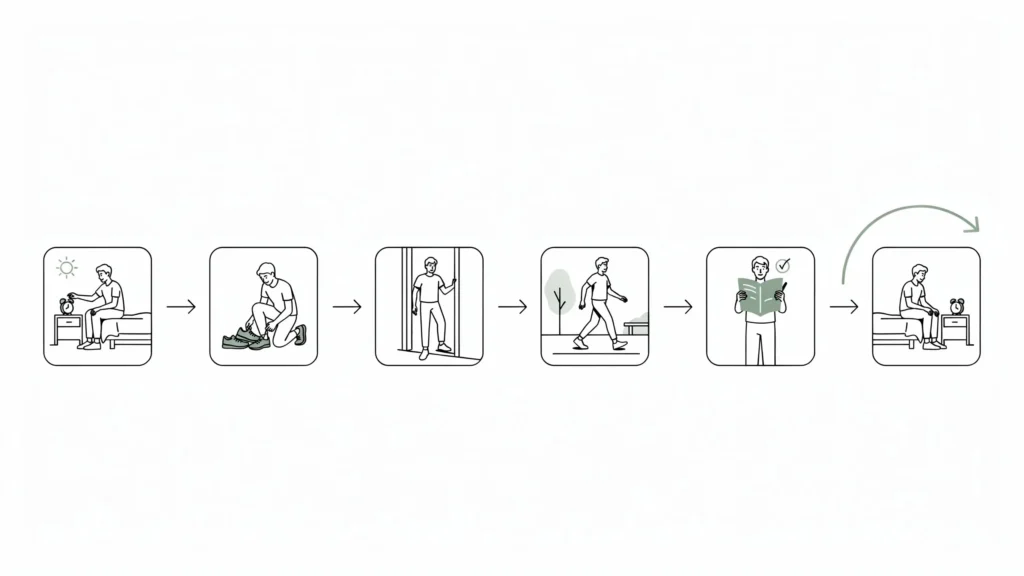
A walk you plan beats a walk you hope for. These five steps removed most of my excuses, and they’re what keep a 30 day walking plan for beginners going past the shaky second week.
- Anchor it to something you already do. Walk right after waking up, right after tea, or right after you get home from college. A habit sticks faster when it has a trigger, not a vague “sometime today.”
- Make the first step ridiculous. Your only job is to put on shoes and step outside. Once you’re out the door, the walk mostly happens on its own.
- Count minutes, not distance. Three songs is roughly 10 minutes if you have music saved. Otherwise, the clock on your phone works.
- Protect the walk from your phone. Start the timer, then switch on Do Not Disturb. I once “walked” for 20 minutes and spent 15 of them scrolling. That isn’t a walk.
- Solve the people problem early. If family sees walking as wasted time, tie it to something useful: walk to the shop, walk the long way to class, or invite a parent along. If you have no one to hold you accountable, tick your tracker where someone can see it.
Benefits of Walking 30 Minutes a Day (and When You’ll Notice Them)

I won’t promise you’ll drop 5 kg in a month. Walking alone changes weight slowly. But here is what people realistically notice during a 30 day walking plan for beginners, roughly in this order:
- Weeks 1 to 2: better mood. You feel calmer and a bit clearer after each walk. For me this was the first and most reliable payoff.
- Weeks 2 to 3: better sleep and steadier energy. Falling asleep gets easier, and the afternoon slump softens.
- Weeks 3 to 4: sharper focus. A walk before studying or after a long session helps many students reset.
- Over months: a healthier body. Staying regularly active, including by walking, is linked with a lower risk of heart disease, stroke and type 2 diabetes, according to the CDC. A short walk after meals can also help blood sugar.
None of this needs equipment. It needs the minutes on your tracker.
If you have a heart condition, joint problems, diabetes or any health concern, check with a doctor before you ramp up.
Walking Myths and Common Mistakes
Myths worth dropping
- “Walking isn’t real exercise.” At a steady or brisk pace, it counts as moderate exercise.
- “You need 10,000 steps.” That number traces back to a 1965 Japanese pedometer named the “10,000 steps meter,” a marketing tool rather than a medical finding, as a Harvard Health post explains. Minutes are easier to follow.
- “You need proper gear.” Comfortable shoes and a timer are enough.
- “One missed day ruins everything.” One missed day is just one missed day.
Mistakes I made (so you don’t have to)
- Starting at 45 to 60 minutes. I ended up with sore shins and quit.
- Walking fast from day one. Speed is the last thing to add. Time comes first.
- Changing everything daily. A new time, route and goal each day means more decisions, and decisions drain you. Keep it boring.
- Pushing through sharp pain. Tired muscles are normal. Sharp or lasting pain in your joints is not. Rest and get it checked.
What to Do When You Miss a Day or Motivation Disappears
You will miss days. Exams, family functions, bad weather and plain tiredness are all normal. What matters is what you do next.
- Never miss twice. One skipped day is a slip. Two in a row starts a new habit, the wrong one.
- Do the 5-minute version. On a bad day, put on your shoes, walk 5 minutes and turn around. Tick the box. It keeps the streak alive and costs almost nothing.
- Drop back one week, not to zero. If you missed three or more days of the 30 day walking plan for beginners, repeat the week before, not Day 1. I used to restart from scratch every time, and that’s why I kept quitting around week two.
- Walk indoors when you must. Heavy rain, extreme heat or bad air? Pace around your home or take the stairs for the same minutes.
Motivation follows action, not the other way around. I rarely felt like walking at the start. I felt fine about it 10 minutes in. So stop waiting to feel ready and trust the trigger from the framework above.
After Day 30: Keeping the Habit for Good
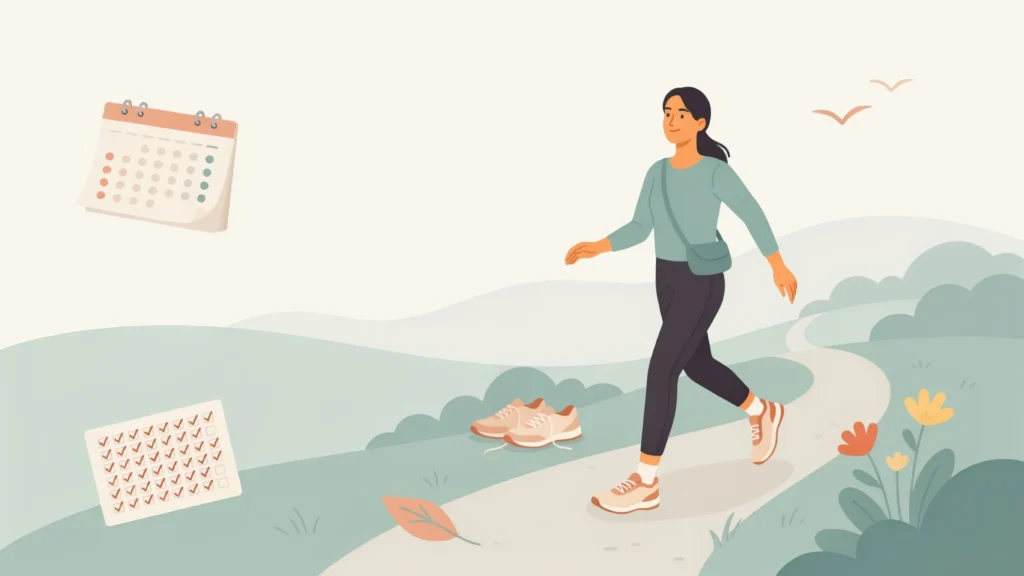
Day 30 isn’t the finish line. A 30 day walking plan for beginners gets you moving, but it doesn’t lock the habit in. The old “21 days to build a habit” idea is a myth. One widely cited University College London study found it took people about 66 days on average for a new behavior to feel automatic, and anywhere from 18 to 254 days depending on the person.
So plan for roughly two to three months:
- Month 2: hold at 30 minutes, 5 days a week. Keep ticking the tracker.
- Month 3: add variety. Try a longer weekend walk of 45 to 60 minutes, a new route, or a walking friend.
- After that: only increase when it feels easy. Add 5 minutes or one hill, not both.
Keep the tracker on the wall for another 30 days. The paper in front of you does more work than willpower ever will.
Frequently Asked Questions
Is 30 minutes of walking a day enough for a beginner?
Yes. Thirty minutes on five days a week matches the common 150-minutes-a-week guideline for moderate activity. You don’t need more to see real benefits.
Can I split my walk into two shorter sessions?
Yes. Two 15-minute walks give you much of the same benefit as one 30-minute walk. Split walks are a good option if your day is packed.
What if I can’t walk 10 minutes at the start?
Start with 5 minutes and add 1 or 2 minutes every few days until you reach 10. Then join the 30 day walking plan for beginners at Day 1. Starting smaller is fine.
Do I need a fitness watch or a step counter?
No. This 30 day walking plan for beginners runs on minutes alone. If you’re curious, 30 minutes of steady walking is usually somewhere around 3,000 to 4,000 steps, but you never need to count them.
Is it better to walk in the morning or evening?
Whichever you’ll actually do. Mornings leave fewer chances for excuses, and an after-meal walk can help blood sugar. Pick one slot for the first two weeks and stick to it.
Summary and Your First Step
To follow a 30 day walking plan for beginners, start at 10 minutes, add about 5 each week, and reach 30 minutes by week 4. Use a timer instead of a watch, tick a paper tracker, and never skip two days in a row. If a day goes wrong, do the 5-minute version and keep going.
Consistency beats intensity. A slow walk you repeat 30 times will do more for you than one heroic hour you never repeat.
Your challenge for today: put on your shoes, set a 10-minute timer, walk out the door and turn around at 5 minutes. Then draw your tracker and tick Day 1 of your 30 day walking plan for beginners.



Pingback: Walking Schedule for Beginners: Easy, Proven 4-Week Plan