
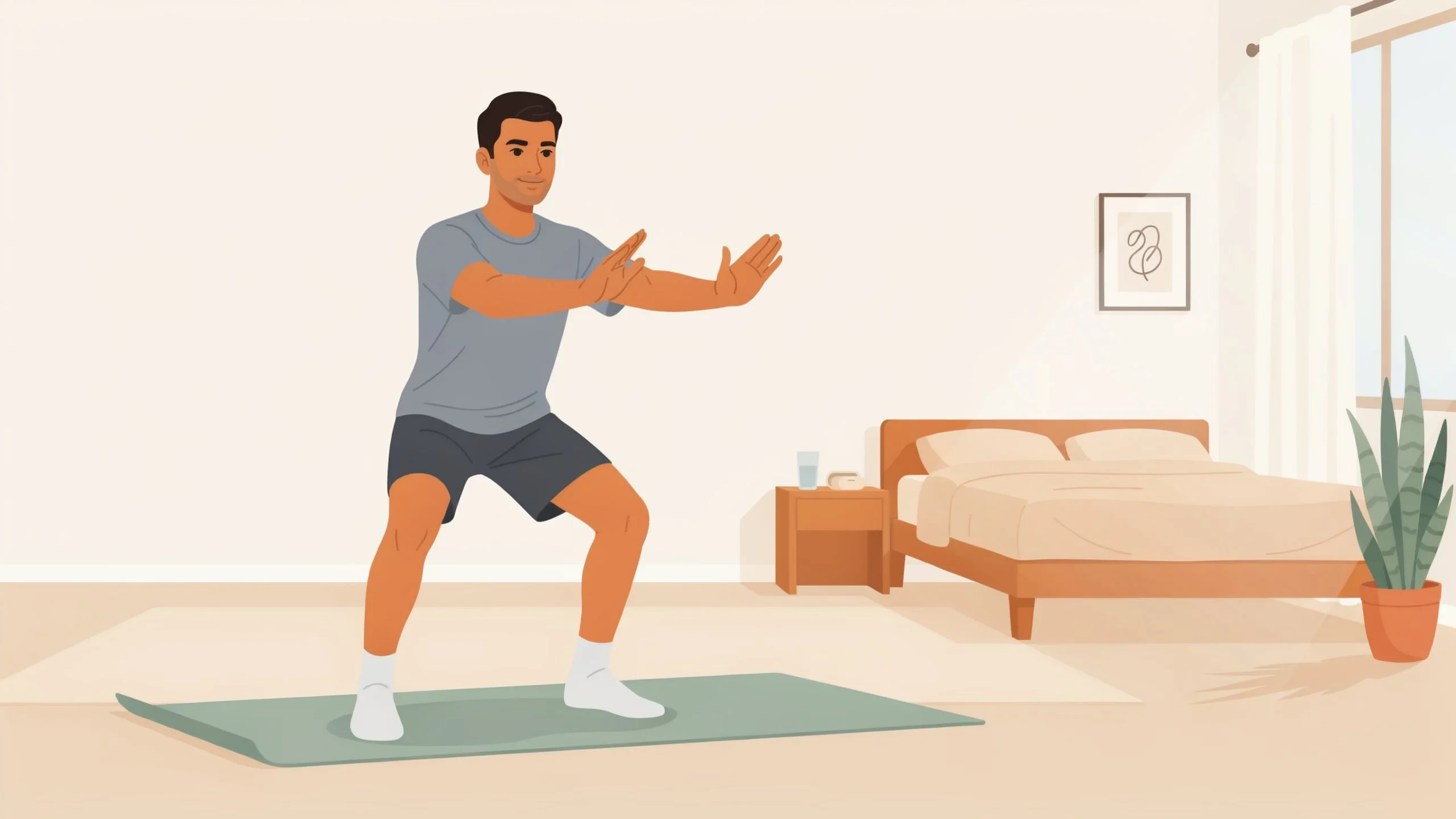
The best home workout for beginners with no equipment is six bodyweight moves, done three days a week for 20 to 30 minutes. It’s a full body workout at home that needs no gym, no gear, and no money.
- The six moves: squats, incline push-ups, glute bridges, reverse lunges, planks, and marching in place.
- The schedule: Monday, Wednesday, Friday. Walk on the other days if you feel like it.
- The progression: Week 1, two rounds. Week 2, add a round. Weeks 3 and 4, add reps, then retest yourself.
- The rule that keeps you going: stop with two reps left in the tank, and never skip two days in a row.
Start today: 2 rounds of 10 squats, 8 wall push-ups, 10 glute bridges, and a 20-second plank. About ten minutes.
Why Most Beginners Quit Within Two Weeks
The real problem isn’t laziness. It’s starting like a person you haven’t become yet.
Nearly every home workout for beginners on the internet asks for too much, too soon.
When I was 19, I had no gym money, a shared room, and a phone that swallowed every evening. I found a 30-day challenge online and did a full hour on day one. I couldn’t walk down stairs properly for three days, and I quit on day four. I repeated that cycle three more times before I understood it.
Why it happens
- Motivation peaks on day one. You’re asking your best mood to carry an average week.
- Soreness feels like punishment. Your brain links the workout with pain, so it starts avoiding it.
- The plan is vague. “Workout today” is a decision, and tired people skip decisions.
- Comparison drains you. Scrolling past someone’s gym progress makes 20 minutes on your bedroom floor feel pointless.
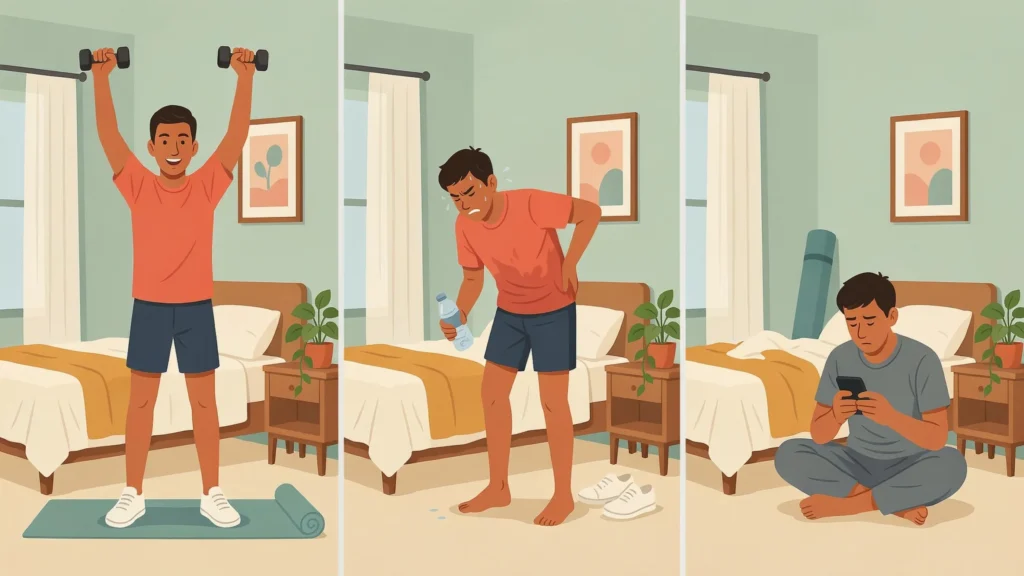
Habits form through repetition in a steady setting, not through intensity. A small cue, an easy action, and a quick sense of “done” build the loop. If you can finish it on your worst day, you’ll repeat it.
What Doesn’t Work: Myths and Mistakes
Myths about a home workout for beginners
- “You need equipment.” For the first several months, bodyweight is plenty. You progress by changing the angle, the speed, and the reps.
- “No sweat, no progress.” Sweat tells you about room temperature, not muscle work.
- “Daily workouts are faster.” Your body adapts while you rest. Three sessions a week beat seven half-hearted ones, and the WHO recommends muscle-strengthening on two or more days a week for adults.
- “Crunches burn belly fat.” You can’t choose where fat leaves. Whole-body training, sleep, and food do that job.
Mistakes I made
- Skipping the warm-up. I tweaked my knee doing jump squats in week two.
- Switching programs every ten days because a new video looked better.
- Training only when I “felt like it,” which turned out to be twice a month.
- Chasing push-up numbers with sloppy form until my shoulders complained.
Before You Start: Your Zero-Cost Setup
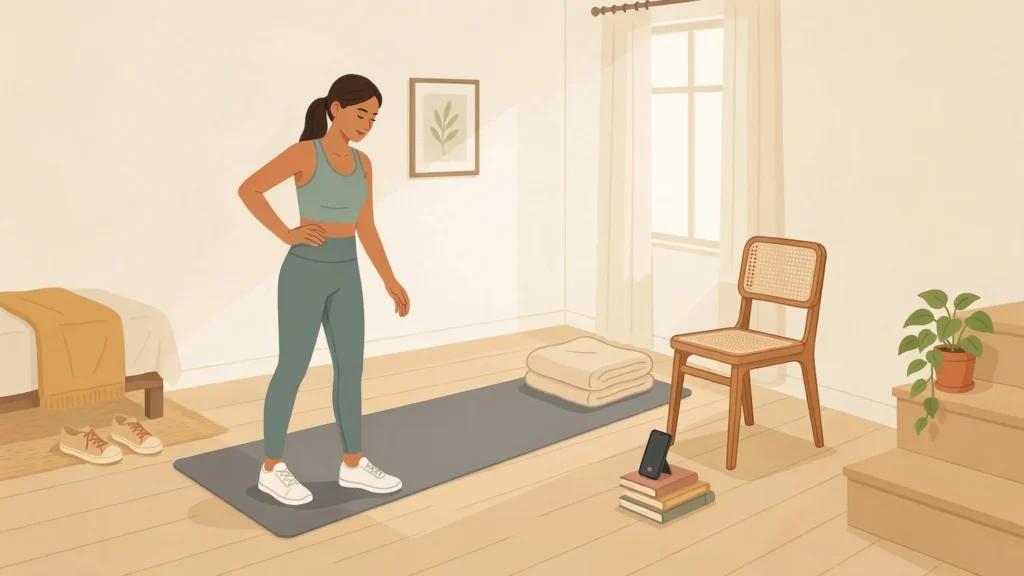
- Space: an area the size of a yoga mat. Beside your bed works.
- Surface: a folded blanket or bedsheet on the floor.
- Props: a wall, sturdy table, or stairs for push-ups, and a chair for balance during lunges.
- A fixed cue: pick a trigger, like right after you change out of college clothes or right after your morning water. I cover how to build these triggers in my post on a simple morning routine.
- A baseline: on day one, note how many squats you do in 60 seconds and how long you hold a plank. You’ll retest in week four.
Film yourself once. Prop your phone against a stack of books and record 10 seconds of each move from the side. Watching your own form beats guessing, and it costs nothing. Under each move below, you’ll see a photo or clip of what the position should look like. For a second opinion on form, the British Heart Foundation’s home strength guide demonstrates squats, glute bridges, and wall push-ups. If you have an injury or a health condition, check with a doctor first.
The 4-Week Plan: A Full Body Workout at Home
Do this circuit three days a week, with at least one rest day in between. Warm up for two minutes first: arm circles, hip circles, and marching. Rest 60 seconds between rounds.
The six moves in this home workout for beginners
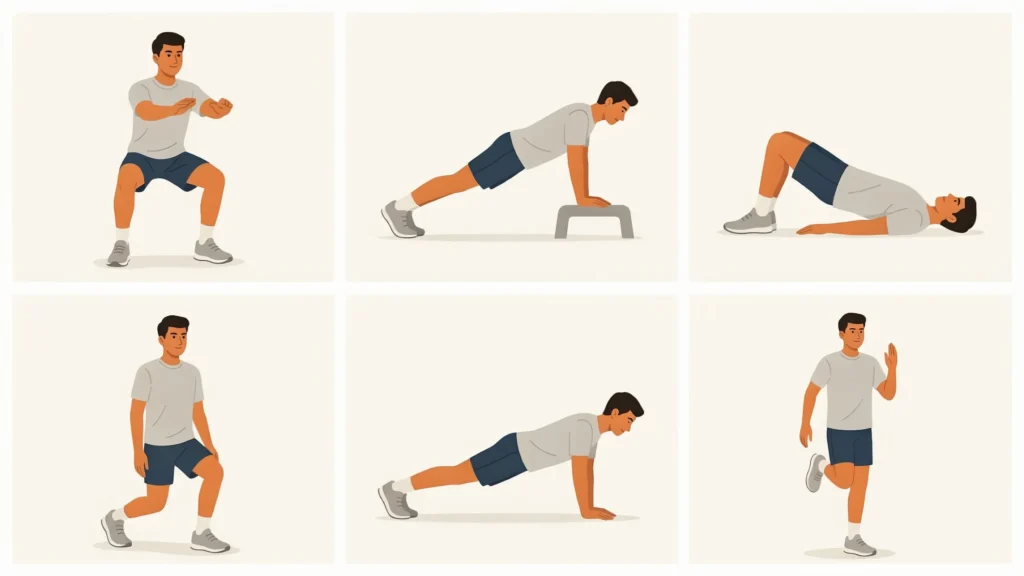
- Bodyweight squat. Feet shoulder-width apart, sit back like there’s a chair behind you, chest up.
- Incline push-up. Hands on a wall or table, body in one straight line, lower your chest slowly.
- Glute bridge. Lie on your back with knees bent, push your hips up, and squeeze for one second.
- Reverse lunge. Step back, lower until the back knee hovers above the floor, and touch a wall for balance.
- Plank. On your forearms, knees down if needed. Keep your ribs down and hips level.
- Marching in place. 30 seconds each round, knees up, arms swinging. Low impact, so your joints stay happy.
Week-by-week progression
| Week | Rounds | Reps per move (lunges per leg) | Plank | Focus |
| 1 | 2 | 8 | 15 sec | Learn the form. Finish feeling you could do more. |
| 2 | 3 | 8 | 20 sec | Add a round, keep the reps. |
| 3 | 3 | 10 | 30 sec | Lower each squat over 3 seconds. Use a lower surface for push-ups. |
| 4 | 3 | 12 | 40 sec | Retest your day 1 baseline in your last session. |
Week 1’s job isn’t fitness. It’s proving to yourself that you can show up three times.
Turning It Into a 30 Day Home Workout Challenge
- Rest days become walk days. Ten easy minutes outside, phone in your pocket. The CDC says adults need about 150 minutes of moderate activity a week, and brisk walking counts.
- Days 29 and 30 are your proof. On day 29, retest your baseline. On day 30, record a short video or take a photo, then write down what changed.
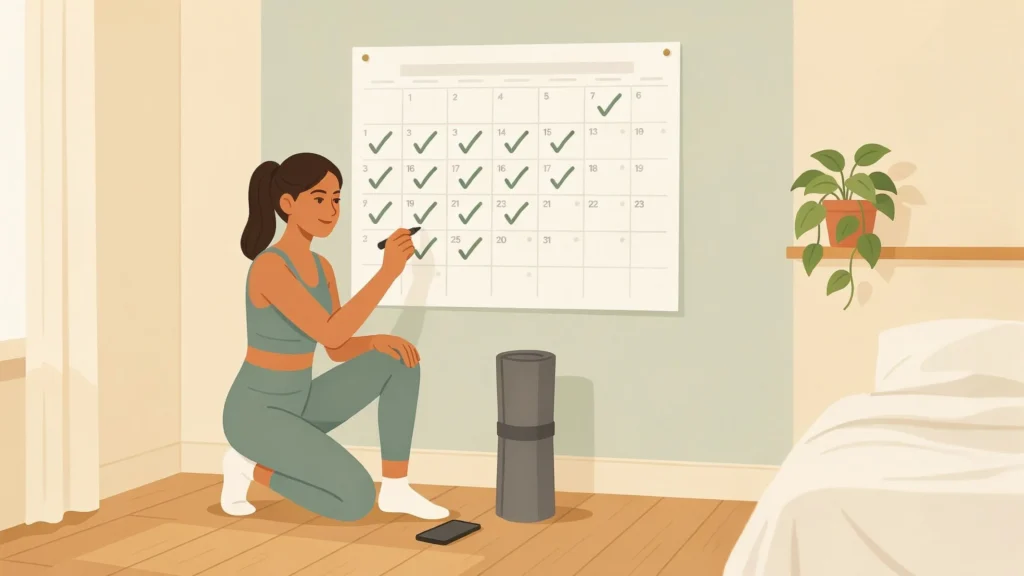
Track it on paper. Hang a calendar where you’ll see it and cross off each finished day. A paper cross feels better than an app notification, and it’s free.
Tell one friend or sibling what you’re doing. Their “did you do it today?” text works harder than willpower.
When You Miss a Day or Motivation Disappears
Missing one day is data. Missing two is how a new habit of quitting starts.
What to do after a miss
- Never miss twice. If Monday is gone, do Tuesday.
- Use the one-round floor. On bad days, do a single round. Five minutes. Most days you’ll keep going, and if you don’t, you still showed up.
- Find the cause. Too tired at 7 pm? Move the session to the morning. Check your schedule before you blame your character.
- Skip the punishment. Don’t stack make-up workouts. That’s how soreness and burnout come back.
When motivation is gone
Motivation is a mood. A system is what’s left when the mood leaves. Lay out your mat the night before. Keep your phone in another room during the session. I break this down in my post on how to build discipline without motivation.
If family thinks it’s a waste of time, train before they wake up or do 10 minutes at a stretch. Nobody has to approve a 15-minute routine.
After Week 4: Keeping It Going for Months
Don’t jump to a brand-new program. Repeat this home workout for beginners with harder versions, and change one thing every four weeks.
A simple progress ladder
- Push-ups: wall, table, stairs, knees, then full floor push-ups.
- Squats: normal, slow lowering, a pause at the bottom, then split squats.
- Plank: 40 seconds, 60 seconds, then lift one foot.
A realistic timeline
- Weeks 1 to 2: the moves feel less awkward, and sleep often improves.
- Weeks 3 to 4: stairs feel easier and your rep counts go up.
- Weeks 8 to 12: visible changes start, if you sleep enough and eat some protein. Eggs, lentils, chickpeas, milk or curd, and peanuts do the job on a small budget. My list of budget-friendly protein foods has more ideas.
FAQ
Can I get fit with a home workout for beginners and no equipment?
Yes. Bodyweight training is enough for the first several months. When a move gets easy, make it harder by going slower, lowering the incline, or using one leg, instead of buying gear.
How long should a beginner workout be?
Twenty to thirty minutes, warm-up included. A short session you finish beats a long one you skip.
What if I can’t do a single push-up?
Start with wall push-ups. When 12 feel easy, move your hands to a table, then stairs, then the floor. That ladder is the plan, not a workaround.
Will this plan burn belly fat?
It builds the base: more muscle, steadier habits, more daily energy. Fat comes off the whole body, not one spot, and it depends on food, sleep, and time. Give it 8 to 12 weeks.
What if I miss days during the 30-day challenge?
Restart the next day and don’t try to make up the missed ones. Count sessions finished, not calendar days. Twelve completed sessions is the real target.
Summary and Your First Step
A home workout for beginners works when it is small enough to repeat: six moves, three days a week, 20 to 30 minutes, adding a little each week. When you miss a day, restart the next one. A boring 20-minute workout you repeat will always beat a brutal one you do once.
Your 2-minute challenge: right now, do 10 squats and 8 wall push-ups. Then write your three training days and start time on paper and stick it on the wall. Nothing to buy. That small session counts as day one.



Pingback: High Protein Vegetarian Food India: 11 Best, Proven Picks