
How can you discipline yourself when you’re broke, unmotivated, and nobody holds you accountable? You build it like a habit — through small, repeated actions, not willpower or motivation. You don’t need money, a coach, or a perfect environment to start.
Here’s the fastest way to discipline yourself today:
- Shrink your goal until skipping it feels silly (5 minutes, not 2 hours).
- Pre-decide the trigger so you’re not negotiating with yourself every morning.
- Track consistency, not intensity — a mediocre effort done daily beats a perfect effort done once
- Add friction to distractions instead of relying on willpower to resist them.
- Plan your comeback in advance, because you will miss days, and that’s not where discipline actually breaks.
Everything below explains why this works, why most zero-budget youth get stuck trying to discipline themselves, and exactly how to build the system step by step.
Why Most Zero-Budget Youth Struggle to Discipline Themselves

I’ve been writing about self-improvement for over 15 years, mostly for broke, ambitious teenagers and young adults who message me things like “I have no gym, no course money, no quiet room — how do I even discipline myself in this situation?” The pattern is almost always the same.
The Motivation Trap
Most people wait to “feel ready” before acting. Motivation is emotional — it depends on sleep, mood, and whether your day went well. If you’re relying on a feeling to show up, you’ve built your entire system on the least stable resource you have.
This hits zero-budget youth harder. Unstable home environments, financial stress, and family tension already drain emotional bandwidth. Waiting to “feel motivated” in that context means waiting forever. If procrastination is the actual root of your problem rather than a lack of a system, my earlier piece on how to stop being lazy digs into that specific trap in more depth.
No Structure Handed to You
A kid with money gets structure by default — a gym membership with fixed hours, a paid tutor who checks homework, a quiet study room. Zero-budget youth have to build every bit of that structure themselves, from nothing.
I once worked with a reader named Ankit, 19, who wanted to learn to code but shared one room with three siblings and one family phone. No one was going to remind him to practice. No one was paying for his accountability. He had to become his own structure — and that’s exactly what disciplining yourself without support actually means in practice.
Environment Beats Willpower
Here’s the psychological piece most advice skips: discipline isn’t really a muscle you flex harder against everything life throws at you. It’s mostly environment design. The American Psychological Association’s own research on willpower describes it as a limited resource that gets depleted through repeated use, which is exactly why relying on raw self-control all day, every day, quietly fails most people.
Your brain runs on cue-routine-reward loops, and social media apps are engineered by teams of people whose entire job is winning that loop against you. You will lose a raw willpower fight against an algorithm. Every time. The fix isn’t more willpower — it’s changing what’s easy to reach.
What Discipline Actually Is (And What It Isn’t)
Discipline isn’t waking up at 4 a.m., cold showers, or grinding until you burn out. It’s simply this: doing what you already decided, even after the feeling behind that decision is gone.
The deeper mechanism is identity, not outcome. Every time you do the small habit, you’re not just making progress on the goal — you’re collecting proof of who you are. “I showed up today” becomes “I’m someone who shows up.” That identity shift is what makes discipline stick long after the original excitement fades, and it’s the real starting point if you want to discipline yourself for good rather than just for a week.
What Doesn’t Work: Common Mistakes When You Try to Discipline Yourself
Copying Someone Else’s Routine
Importing a stranger’s 5 a.m.-cold-shower-10km-run routine off YouTube usually collapses within a week, because it wasn’t built for your constraints — a joint family, a shared phone, zero privacy, a family business you’re expected to help with.
All-or-Nothing Thinking
I did this myself for years. Miss one gym day, and I’d treat the entire streak as “ruined,” then take three weeks off out of shame. One missed day is data. Treating it as a total failure is the actual habit-killer.
Depending on Big Motivation Pushes
Two weeks of hardcore intensity followed by a total crash is a pattern, not bad luck. The body and mind rebound hard after unsustainable effort — that crash isn’t weakness, it’s physics.
No Way to Track Progress
Without any record — even a scrap of paper — your brain can’t register the small wins. Discipline feels invisible, so it quietly fades. You can’t improve what you don’t measure, even informally.

How to Discipline Yourself Without Money: The Zero-Cost Framework
This is the exact five-step system I use with readers who have nothing to work with except time and a decision. I also broke a version of this down as a full system in Breaking Laziness: A Simple Discipline System for Youth if you want a second walkthrough alongside this one.
Step 1: Shrink the Target Until You Can’t Say No
Don’t commit to “read for an hour.” Commit to “read one page.” Don’t commit to “study for two hours.” Commit to “open the book and do one problem.” Tiny actions bypass the brain’s resistance because there’s nothing to resist.
Step 2: Pre-Decide, Don’t Negotiate Daily
Attach the new habit to something you already do without thinking — this is called habit stacking, and it’s completely free. “After I brush my teeth, I do 10 push-ups.” The old habit becomes the trigger for the new one, so you’re not relying on memory or mood.
Step 3: Design Friction on Both Sides
Make the good habit easier to start — keep the book on your pillow, keep your notebook open on the desk. Make the bad habit harder to reach — log out of Instagram after every use, keep your phone outside the room while studying, delete the app and only use the browser version.
Step 4: Track Consistency, Not Perfection
Use a free notebook, a wall calendar, or the back of an old exercise book. Mark an X for every day done. Track it weekly (say, 5 out of 7 days) instead of demanding an unbroken daily streak — rigid streaks make one bad day feel catastrophic.
Step 5: Review Weekly, Not Daily
Every Sunday, spend 10 minutes asking: What worked? What didn’t? What’s one thing I’ll adjust? Small weekly corrections beat daily overthinking.
Zero-Cost Tools That Help You Discipline Yourself Today
You don’t need a paid app to discipline yourself. These cost nothing and work immediately:
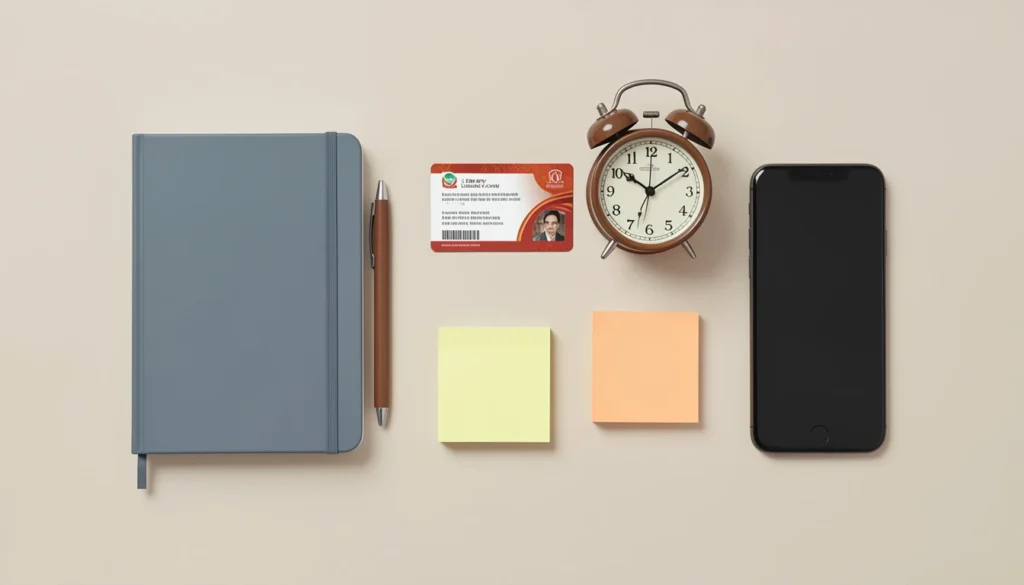
- A physical notebook or wall calendar — mark your streak by hand; it’s harder to lie to yourself on paper than on a screen.
- Your phone’s built-in screen-time settings — set a hard daily limit on distracting apps instead of relying on your own resistance
- A cheap alarm clock — keep your phone charging outside the bedroom so it’s not the first or last thing you touch each day
- A library card — free books, free internet access, and a physically quiet space designed for focus
- An accountability text partner — one friend you message “done” or “missed” to every night, no app required
- Sticky notes as environment cues — placed where the bad habit usually starts, as a physical interruption to autopilot
A Realistic Timeline to Discipline Yourself (Because “21 Days” Is a Myth)
The popular claim that habits form in 21 days isn’t accurate — it traces back to a 1960s book about plastic surgery patients, not habit research. The actual research, a well-known University College London study on habit formation, tracked real participants and found it took an average of 66 days for a new behavior to become automatic, with a range of roughly 18 to 254 days depending on how complex the habit was.
- Week 1–2: It feels forced. The Effort required is at its highest. This discomfort is normal, not a sign you’re doing it wrong.
- Week 3–8: The habit needs less negotiation but is still fragile. One rough week can derail it — expect a wobble here.
- Around day 66 (roughly month 2): Identity starts shifting. The thought “I’m someone who does this” begins showing up on its own, matching what the UCL research found as the average plateau point.
- Beyond that: The habit runs mostly on autopilot, though occasional resets are still normal. Discipline isn’t “achieved” once — it’s maintained indefinitely.
Common Myths About Self-Discipline
- Myth: Disciplined people never feel like quitting. Reality: They feel like quitting constantly — they just act anyway.
- Myth: You need to wake up early to be disciplined. Reality: Consistency within your real rhythm beats a forced 5 a.m. wake-up you can’t sustain.
- Myth: Motivation comes first, then discipline follows. Reality: Action creates motivation, not the reverse.
- Myth: You need money — courses, gym memberships, apps — to discipline yourself. Reality: The core mechanism costs nothing.
- Myth: One missed day ruins everything. Reality: The second missed day is what actually breaks a habit, not the first.
What to Do When You Fail to Discipline Yourself
Failure isn’t the exception in discipline-building — it’s part of the process. What matters is the recovery method.
- Don’t skip twice. One missed day is data. Two in a row is the start of a new pattern.
- Return at the smallest version, not full intensity. Don’t “make up for lost time” by doing triple the work — that’s how the next quit starts.
- Investigate the trigger honestly. Was it a fight at home? Phone in hand at bedtime? Write down what actually happened.
- Drop the guilt story. Replace “I’m lazy” with “my system had a gap, and I’m fixing the gap.” One is an identity attack; the other is a system fix.
A Real Story: How I Learned to Discipline Myself the Hard Way
Years ago, I tried a self-imposed hardcore routine — 5 a.m. wake-up, cold shower, two hours of study — while living in a joint family, sharing a room, with constant interruptions and family expecting help in the shop. I failed by day six and felt genuinely ashamed.

I rebuilt it smaller: 10 minutes of reading plus 10 push-ups, anchored to bedtime, tracked on the back of an old exercise notebook. Over four months, it became automatic, and only then did I add more.
The lesson: your circumstances don’t need to change for discipline to work. Only the size of your first target does.
Long-Term Sustainability: Discipline as Identity, Not a Project
Discipline isn’t a 30-day challenge you finish and move on from — it’s a maintained system, the same way brushing your teeth is. Nobody feels “motivated” to brush their teeth; it’s just identity now.
When life disrupts your system — exams, a new job, a family crisis — rebuild smaller instead of quitting entirely. A shrunk-down version of the habit kept alive is worth more than a perfect version abandoned. This is what it actually looks like to discipline yourself over years, not just for one good month.

Frequently Asked Questions About How to Discipline Yourself
How can I discipline myself without any money or resources?
Shrink your target to something under five minutes, attach it to an existing daily habit, and track it on free paper. The mechanism behind self-discipline doesn’t require paid tools.
How long does it actually take to discipline yourself into a new habit?
Longer than 21 days for most habits. UCL’s Lally et al. research found an average of 66 days to automaticity, so expect meaningful progress closer to two or three months, not three weeks.
What if my family doesn’t support my discipline goals?
Design around the constraint instead of fighting it. Anchor your habit to a private moment — early morning, after everyone sleeps — and keep the goal private at first so it isn’t mocked or pressured before it’s stable.
How do I stay disciplined when I don’t feel motivated?
Discipline is designed to work without motivation. Pre-decided triggers and small task sizes mean the action doesn’t require you to feel ready — willpower research backs this up, since relying on raw resolve alone tends to run out by the end of the day.
What’s the biggest mistake youth make when trying to discipline themselves?
Copying someone else’s high-intensity routine instead of designing one around their own real daily constraints.
Can you really build self-discipline with zero budget?
Yes. Every step in this framework — shrinking targets, habit stacking, paper tracking, environment friction — uses tools you already own. Discipline was never actually a money problem.
Final Word: Start Smaller Than Feels Necessary
Discipline isn’t built through a single dramatic decision — it’s built through a small action, repeated until it becomes identity. If you’ve been asking how can you discipline yourself with none of the usual support, the honest answer is: no money, mentor, or perfect environment required — just a target small enough that skipping it feels pointless.
Your action challenge: Pick one habit. Shrink it to under two minutes. Do it today, right after reading this, before opening any other app. Track it on paper for seven days. That’s the whole start.
Consistency over intensity — that’s the entire game.